
Introduction
In today’s digital world, passwords protect almost every part of our online life. From email accounts and social media profiles to banking apps and work tools, passwords act as the first line of defense. Unfortunately, many people still use weak or easy-to-guess passwords. This makes cybercriminals’ jobs much easier and puts personal data at risk. That is why learning strong password creation tips is no longer optional. It is a basic digital skill everyone needs.
Strong password creation tips help beginners and intermediate users understand how to build passwords that are hard to crack but still easy to manage. A strong password does not need to be complicated or impossible to remember. It simply needs the right structure, length, and uniqueness. When done correctly, it can block most common hacking attempts.
What is Strong Password Creation Tips?
Strong password creation tips are practical guidelines that help users design secure passwords for online accounts. These tips focus on making passwords difficult for hackers to guess or crack using automated tools. Instead of relying on simple words or personal information, strong passwords use a smart mix of characters and patterns.
At their core, strong password creation tips encourage longer passwords. Length plays a major role in security because longer passwords create more possible combinations. Even a simple password becomes much stronger when it is long enough.
Another key idea behind strong password creation tips is unpredictability. Passwords should not follow obvious patterns or include common words. Hackers often start with known password lists, dictionary words, and leaked data. A strong password avoids these traps.
These tips also emphasize uniqueness. Using the same password on multiple sites is risky. If one site is breached, attackers can access other accounts. Strong password creation tips recommend a different password for every important account.
Finally, these tips balance security with usability. A strong password should be secure but still manageable. With the right techniques, users can create passwords that are both safe and memorable without writing them down in unsafe places.
Why is Strong Password Creation Tips Important?

Strong password creation tips are important because online threats continue to grow every year. Hackers constantly improve their tools, making weak passwords easier to break. Without proper password habits, even careful users can become victims of data breaches.
One major reason these tips matter is account protection. A strong password helps protect emails, financial data, and personal messages. Once attackers access an email account, they can reset passwords for other services.
Another reason is identity safety. Weak passwords can lead to identity theft. Hackers may use stolen information to open accounts, make purchases, or commit fraud in someone else’s name. Strong password creation tips reduce this risk.
Businesses and workplaces also depend on password security. A single weak password can expose sensitive company data. Employees who follow strong password creation tips help protect their organization and their own jobs.
These tips are also important because many attacks are automated. Hackers do not target individuals manually. They use software to test common passwords across thousands of accounts. Strong passwords are designed to resist these automated attacks.
In short, strong password creation tips help users stay safe, reduce stress, and avoid costly problems. They are a simple habit that offers powerful protection in a connected world.
Detailed Step-by-Step Guide
Step 1: Start With a Long Password
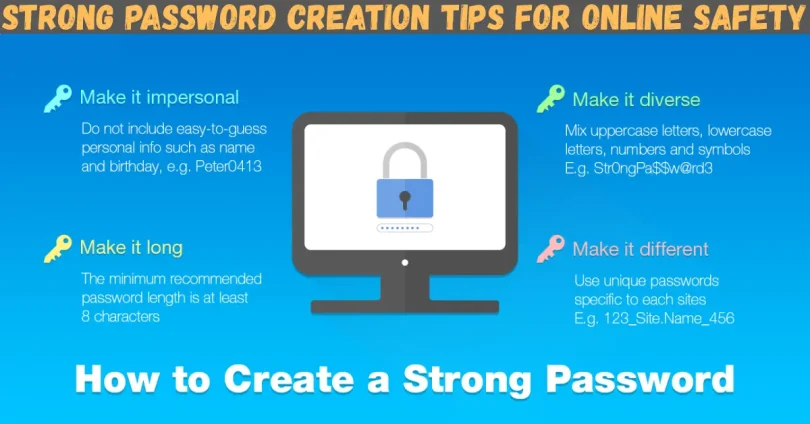
Length is one of the most important factors in password strength. Aim for at least twelve characters, and more if possible. Longer passwords take much longer to crack.
For example, “sun123” is weak, but “SunnyRiverMorning2025” is much stronger. Even simple words become secure when combined and extended.
Step 2: Use a Mix of Characters
Strong password creation tips always recommend using a mix of characters. This includes uppercase letters, lowercase letters, numbers, and symbols.
A varied password increases complexity. For example, “Password2025” is weak, but “P@ssw0rd!2025” is stronger. Avoid predictable replacements, though, as hackers know common patterns.
Step 3: Avoid Personal Information
Never include personal details such as your name, birthday, phone number, or favorite team. Hackers can find this information easily through social media.
Instead of “Ali1995,” choose something unrelated to your personal life. This makes guessing much harder.
Step 4: Create a Passphrase
A passphrase is a group of random words combined into one password. This method is both secure and easy to remember.
For example, “BlueChairRunsFastSky” is long, unique, and memorable. Passphrases are one of the most effective strong password creation tips.
Step 5: Make Each Password Unique
Using the same password everywhere is dangerous. If one site is hacked, all accounts are at risk.
Create a unique password for important accounts like email, banking, and cloud storage. This limits damage if a breach occurs.
Step 6: Use a Pattern Only You Know
You can create a personal system for passwords. For example, add a unique word related to the website.
This approach helps you remember passwords while keeping them different. Just ensure the pattern is not obvious.
Step 7: Change Passwords When Needed
You do not need to change passwords often unless there is a reason. However, if a site reports a breach, update your password immediately.
Strong password creation tips include staying alert and acting quickly when risks appear.
Step 8: Store Passwords Safely
Never write passwords on paper or store them in plain text files. Consider using a trusted password manager to keep them secure.
A password manager allows you to create and store strong passwords without memorizing them all.
Benefits of Strong Password Creation Tips
- Protects personal and financial information
- Reduces the risk of hacking and identity theft
- Keeps email and social media accounts secure
- Limits damage from data breaches
- Builds safer online habits
- Saves time and stress caused by account recovery
Disadvantages / Risks
- Strong passwords can be harder to remember at first
- Managing many unique passwords may feel overwhelming
- Password managers require trust and proper setup
- Forgetting a strong password can lock you out temporarily
Common Mistakes to Avoid
Many users know about strong password creation tips but still make mistakes. One common error is using short passwords. Short passwords are easy targets for automated attacks.
Another mistake is reusing passwords across multiple sites. This creates a single point of failure. If one account is compromised, others follow quickly.
People also rely too much on simple substitutions. Replacing “a” with “@” or “o” with “0” is no longer enough. Hackers expect these patterns.
Writing passwords on sticky notes or saving them in browsers without protection is also risky. Physical access or malware can expose them.
Finally, ignoring breach warnings is a serious mistake. When a service alerts users to a security issue, changing the password immediately is critical.
FAQs
What makes a password strong?
A strong password is long, unique, and unpredictable. It uses a mix of characters and avoids personal information. Strong password creation tips focus on these qualities.
How long should my password be?
Experts recommend at least twelve characters. Longer passwords provide more security and resist brute force attacks more effectively.
Are passphrases better than complex passwords?
Yes, passphrases are often better. They are longer and easier to remember while still being very secure when chosen randomly.
Should I change my passwords regularly?
Only change passwords when there is a breach or risk. Frequent changes without reason can lead to weaker choices.
Is it safe to use a password manager?
A trusted password manager is generally safe and helpful. It stores passwords securely and helps generate strong ones.
Can strong passwords stop all hacking attempts?
Strong passwords greatly reduce risk but cannot stop every threat. Combined with good habits, they offer excellent protection.
Expert Tips & Bonus Points
One expert tip is to focus on length over complexity. A long, simple passphrase can be stronger than a short, complex password.
Another bonus tip is to secure your email account first. Since email controls password resets, it should have the strongest password.
Consider enabling account alerts. Notifications can warn you about unusual login attempts or changes.
Review your old accounts. Many forgotten accounts still contain personal data and weak passwords. Update or close them when possible.
Finally, teach strong password creation tips to family members. Shared knowledge improves overall digital safety.
Conclusion
Strong passwords are a simple yet powerful way to protect yourself online. With cyber threats increasing every year, relying on weak or reused passwords is a serious risk. Strong password creation tips provide clear, practical guidance that anyone can follow, regardless of technical skill. By focusing on length, uniqueness, and unpredictability, users can dramatically improve their online security.
Throughout this guide, you learned what strong password creation tips are, why they matter, and how to apply them step by step. You explored benefits, risks, common mistakes, and expert advice designed to make password security manageable and effective. These tips are not about fear or complexity. They are about building smart habits that work in real life.